
Contract Analysis
Contract analysis is the heart of UK Legal Skills. These seven commands help you understand exactly what you are signing -- before you sign it. Whether you need a full review, a risk breakdown, or help negotiating better terms, there is a command for it.
Seven commands for reviewing, comparing, and benchmarking contracts under the laws of England and Wales.
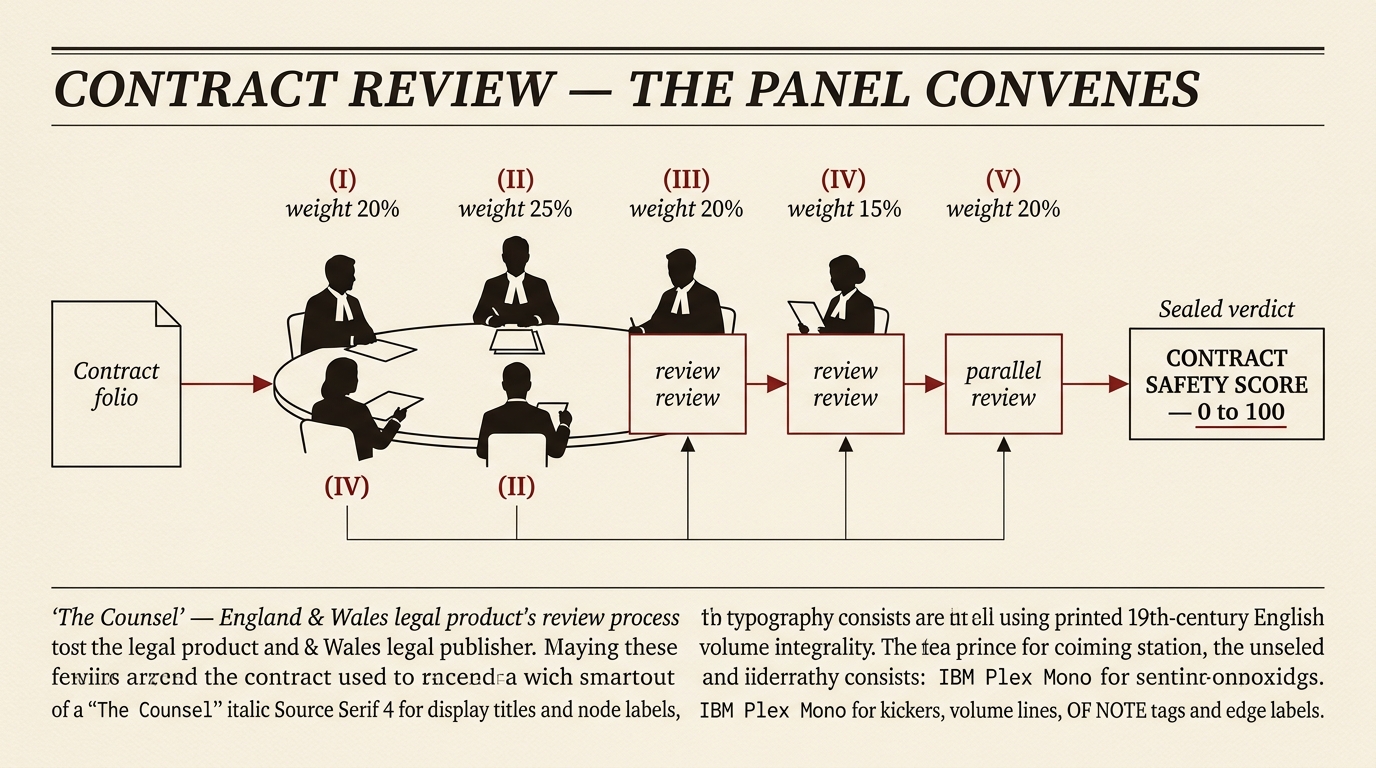
Plate I — the broadsheet rebrand.
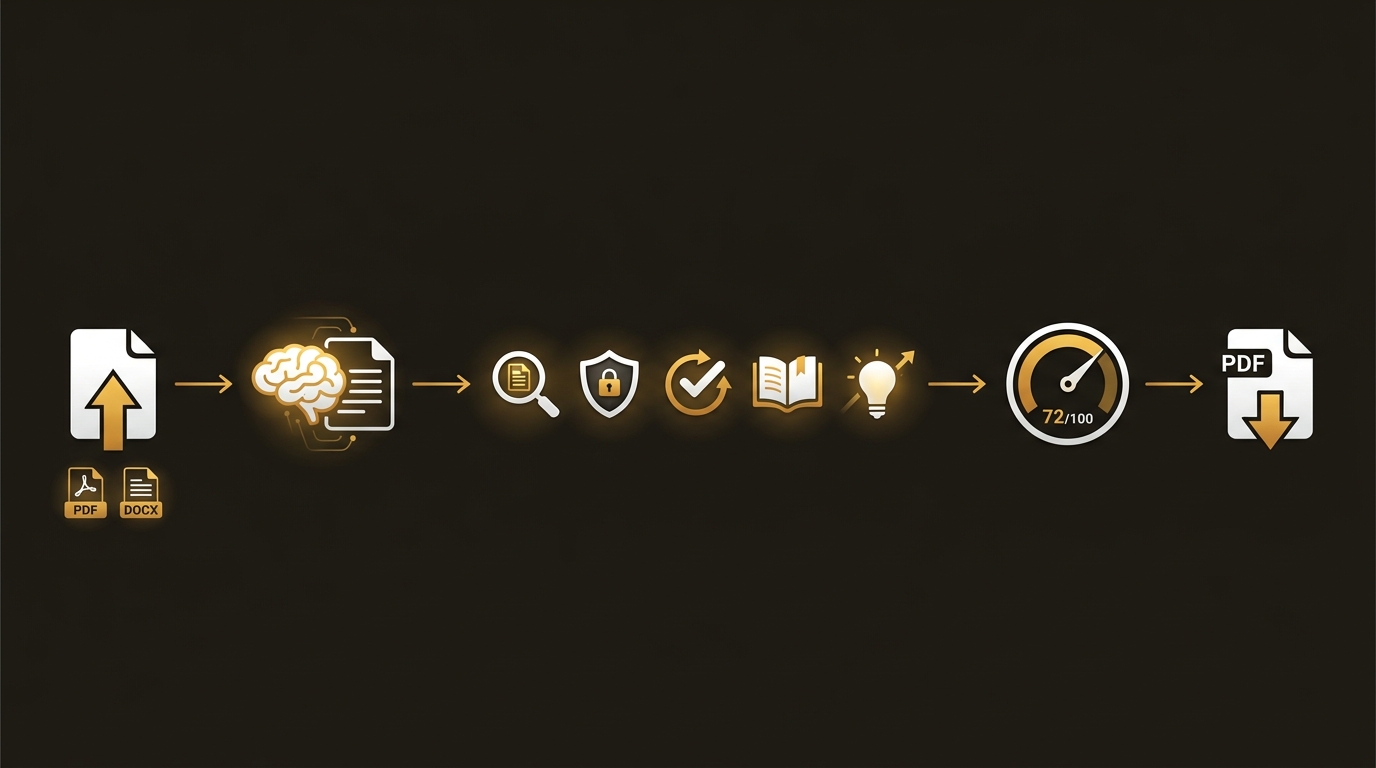
Plate I.a — the original, kept for reference.
/legal first-read
Why use this? A contract has just landed in your inbox and you need a view in seconds, not an afternoon. This is the senior-counsel triage: a sub-15-second opinionated first read that classifies the contract, scores the top issues on a likelihood × severity matrix, and hands you one verdict -- SIGN, NEGOTIATE, or WALK -- before you commit to a full review.
The natural entry point. It does not exposit clause-by-clause -- it forms a view. Think of a senior partner reading a contract over coffee: fifteen seconds, one verdict, a tight risk matrix, and a steer. The deep work, if it is needed, follows -- RED-tier contracts auto-route to /legal review.
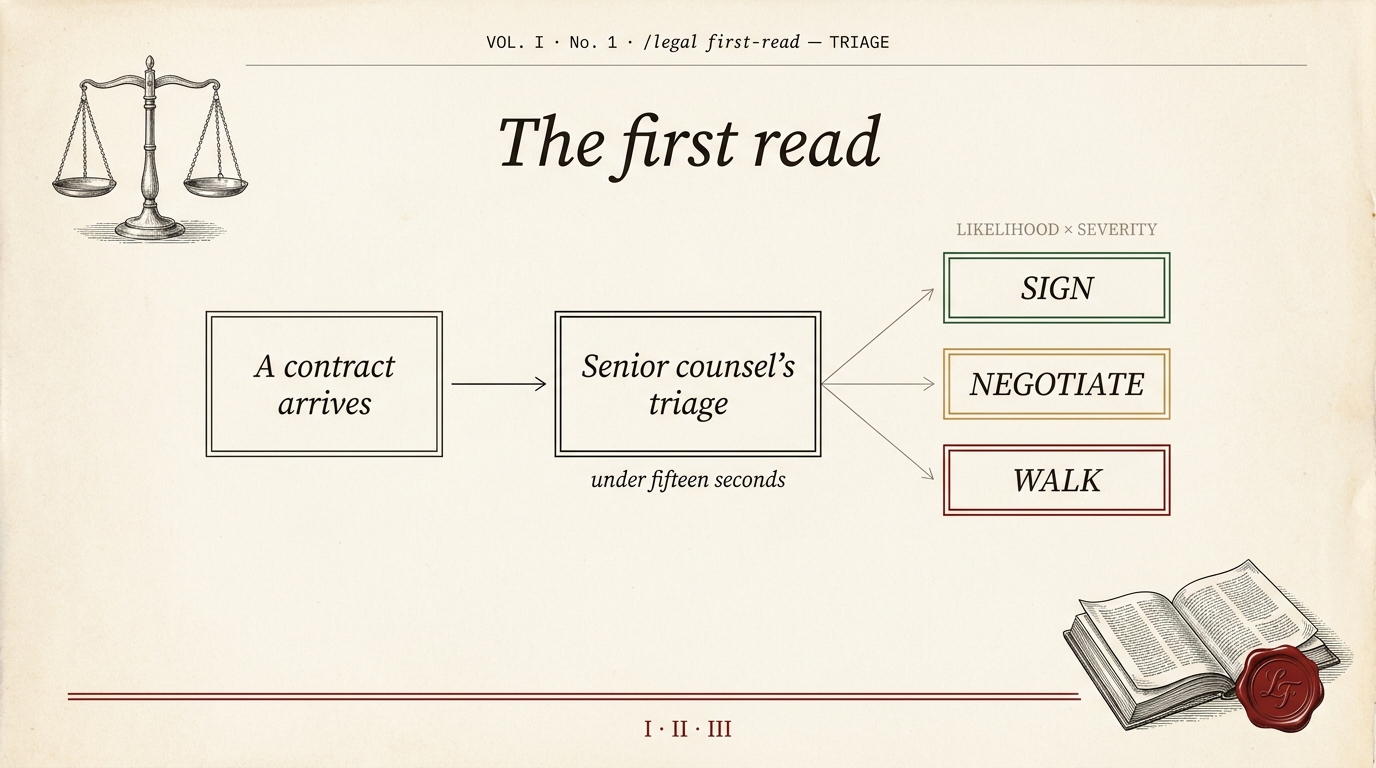
Plate II — the senior-counsel triage.
Syntax
/legal first-read <file>Accepts all three input shapes: a file path, pasted contract text, or a URL to a contract document.
What it does
- Phase 0 -- Escalation check (runs first): Scans for signals that demand a solicitor now -- active litigation or pre-action correspondence (LBA, Part 36, claim form), regulator action (FCA, ICO, HMRC, SRA, CMA, Ofcom, HSE), a personal data breach affecting 100+ subjects or special-category/children's data, criminal-liability exposure (ECCTA failure-to-prevent fraud, MLR, bribery, sanctions), a limitation period under 30 days, director personal-liability indicators, or a whistleblowing disclosure. If any fire, the output is topped with an ESCALATE -- INSTRUCT A SOLICITOR NOW banner naming the trigger.
- Phase 1 -- Classify: Identifies the contract type in the first pass and calibrates severity and likelihood priors against it (see the type lookup below).
- Phase 2 -- Matrix: Picks the top five issues maximum (fewer is better on a clean contract), scores each for severity and likelihood, and reads off the tier.
- Phase 3 -- Verdict: Returns one editorial headline -- SIGN, NEGOTIATE, or WALK -- with a two-to-three-sentence partner-style rationale.
- Phase 4 -- Auto-escalate: Where the trigger conditions fire, ends with an explicit hand-off to /legal review for the full five-agent deep dive.
Contract types it triages
The classifier maps signals to type and to where the money typically goes wrong:
| Signals | Likely type | Where the money goes wrong |
|---|---|---|
| Deliverables, retainer, statement of work | Services / MSA / SOW | Scope creep, payment timing, IP ownership, termination for convenience |
| Salary, notice period, post-termination restrictions | Employment | Restrictive covenants, IP assignment, statutory floor, discrimination |
| Confidential information, receiving party, residual knowledge | NDA | Definition breadth, term, permitted disclosures, IP carve-outs |
| Subscription, SLA, uptime, licence grant, processor terms | SaaS | Auto-renewal, data ownership, liability cap vs fees, UK GDPR Art. 28 |
| Independent contractor, IR35, off-payroll, kill fee | Freelance / Contractor | Worker-status risk, IP assignment, substitution clauses |
| Landlord, tenant, premises, rent review, break clause | Lease / Tenancy | Repair obligations, dilapidations, break conditionality |
| Buyer, seller, purchase price, completion accounts, warranties | M&A / SPA | Warranty cap, indemnity scope, disclosure letter, earn-out mechanics |
| Investor, valuation cap, drag/tag, pre-emption | Investment / SHA / SAFE | Liquidation preference, board control, dilution, founder vesting |
| Facility, security, covenants, events of default | Finance | Cross-default, MAC clauses, security perfection, enforcement triggers |
For employment and lease signals the skill applies the Employment Rights Act 1996 statutory floor and notes any reform whose status it needs to verify (for example the Renters' Rights Act 2025 as its provisions commence, or post-2024 employment reforms) -- it labels these "status to verify" rather than asserting they are in force, and the skills run live in-force checks where the host provides legislation tools.
The likelihood × severity matrix
Each issue is scored on two axes and the tier read straight off the grid.
Severity -- financial exposure plus enforceability under England and Wales law:
| Level | What it means |
|---|---|
| HIGH | Uncapped or multi-million exposure; loss of a core asset (IP, key data, premises); criminal or regulatory liability; breach of a statutory floor |
| MEDIUM | Capped but material exposure; meaningful operational drag; defensible if litigated |
| LOW | Annoying, asymmetric, but commercially survivable |
Likelihood -- the probability the clause actually bites, calibrated to counterparty, deal size, industry norms, and whether the trigger is mandatory or discretionary: LIKELY, POSSIBLE, or UNLIKELY.
| Severity \ Likelihood | LIKELY | POSSIBLE | UNLIKELY |
|---|---|---|---|
| HIGH | RED | RED | AMBER |
| MEDIUM | AMBER | YELLOW | YELLOW |
| LOW | YELLOW | GREEN | GREEN |
Likelihood is the point
This skill weights likelihood deliberately -- the half the deeper reviews tend to under-weight. A theoretical uncapped indemnity that no rational counterparty would ever invoke is not the same risk as one with an easy trigger and a clear motive. The triage calibrates to deal context rather than treating every clause as live.
The verdict
| Verdict | When |
|---|---|
| SIGN | Only GREEN and YELLOW issues. Within market norms for the type. A defensible commercial decision today. |
| NEGOTIATE | YELLOW plus AMBER, where the AMBER is fixable in a single round of mark-up. Worth pushing back on; not worth walking. |
| WALK | Any RED-tier issue, or AMBER concentrated in unilateral terms (one-sided termination, uncapped indemnity, broad assignment, sole-discretion drafting). Not salvageable as written without a structural rewrite. |
When it auto-routes to /legal review
The triage forces a hand-off to the deep review when:
- Any RED-tier issue appears in the matrix.
- The type is M&A / SPA, Investment / SHA / SAFE, Employment with post-termination restrictive covenants, Lease with a term over five years, or a Finance facility with security.
- The verdict is WALK.
- The prompt signals high stakes (deal value, regulatory sensitivity, board approval pending).
In those cases the output ends with an explicit line pointing to /legal review for the weighted Contract Safety Score across five parallel agents.
Example
/legal first-read ./contracts/acme-msa.pdfOutput
FIRST-READ-[short-name]-[date].md containing:
- The canonical AI-generated legal analysis disclaimer (and, where triggered, the ESCALATE banner above it)
- A metadata table (contract type, parties, effective date, governing law, analysis date)
- The VERDICT headline (SIGN / NEGOTIATE / WALK) with a partner-voice rationale
- The risk matrix (up to five issues, each with severity, likelihood, tier, and a one-line rationale)
- A "Top 3 to push back on" or "Top 3 walk-away reasons" list (omitted when the verdict is SIGN)
- A hand-off to
/legal reviewfor the full deep dive
Plain-text tiers, not the usual indicators
The deeper skills use 🔴 / 🟡 / 🟢. This triage deliberately uses RED / AMBER / YELLOW / GREEN labels in plain text -- it is a different register, the broadsheet leader column rather than the clause-by-clause file note.
Related commands
- /legal review -- the full five-agent deep dive a RED-tier first read routes to
- /legal risks -- clause-by-clause severity scoring with financial exposure
- /legal negotiate -- counter-proposals and replacement language once you decide to push back
- /legal missing -- protections that should be present but are not
/legal review
Why use this? You have been sent a contract. Before you sign, you want to know: is this safe? What are the risks? What should I push back on?
The flagship command. Launches 5 parallel agents that analyse every aspect of a contract and produce a unified report with a Contract Safety Score.
Syntax
/legal review <file>What it does
- Phase 1 -- Ingestion: Reads the contract, classifies the type (service agreement, employment, NDA, SaaS, freelancer, partnership, lease, sales, investment), and extracts metadata (parties, dates, value, governing law).
- Phase 2 -- Parallel analysis: Launches five subagents simultaneously:
| Agent | Role | Weight |
|---|---|---|
legal-clauses | Identifies and categorises every clause | 20% |
legal-risks | Scores each clause for risk level | 25% |
legal-compliance | Flags regulatory and legal issues | 20% |
legal-terms | Maps duties, deadlines, and triggers | 15% |
legal-recommendations | Generates specific fixes for every issue | 20% |
- Phase 3 -- Aggregation: Merges findings into a weighted Contract Safety Score (0--100).
Scoring
| Score | Grade | Label |
|---|---|---|
| 90--100 | A+ | Safe |
| 80--89 | A | Good |
| 70--79 | B | Fair |
| 60--69 | C | Caution |
| 40--59 | D | Risky |
| 0--39 | F | Dangerous |
Example
/legal review ./contracts/saas-agreement.pdfOutput
CONTRACT-REVIEW-[name]-[date].md containing:
- Contract Safety Score with grade
- Executive summary
- Risk dashboard (high/medium/low counts)
- Clause-by-clause analysis with replacement language
- Missing protections
- Obligations and deadlines table
- Negotiation priorities (ranked)
- Recommended next steps checklist
/legal risks
Why use this? You want to know the financial exposure of every clause. How much could each provision actually cost you?
Deep clause-by-clause risk analysis with severity scoring and financial exposure estimates.
Syntax
/legal risks <file>What it checks
Every clause is scored 1--10 across these risk categories:
| Category | Examples |
|---|---|
| Financial Exposure | Uncapped liability, penalty clauses, liquidated damages |
| Liability Transfer | Broad indemnification, hold harmless, insurance shifts |
| Restrictive Covenants | Non-competes, exclusivity, right of first refusal |
| Unclear/Ambiguous Terms | "Reasonable efforts," undefined key terms |
| Missing Protections | No liability cap, no termination for convenience |
| One-Sided Terms | Unilateral amendment, asymmetric termination |
| Auto-Renewal Traps | Short cancellation windows, price escalation |
| IP Assignment Overreach | Pre-existing IP capture, broad "arising from" language |
Hidden risk detection
The command specifically hunts for patterns that are commonly missed:
- Definition landmines -- terms defined broadly in Section 1 that expand liability later
- Cross-reference traps -- clauses referencing other sections to quietly expand obligations
- Buried carve-outs -- exceptions in sub-sub-clauses that override earlier protections
- Survival clauses -- obligations surviving termination indefinitely
- Incorporation by reference -- external documents that can change without notice
- Defined term drift -- terms defined one way but used differently in the body
Example
/legal risks ./contracts/vendor-agreement.docxOutput
RISK-ANALYSIS.md containing:
- Overall risk score (X/10)
- Risk matrix table with financial exposure per clause
- Total estimated financial exposure
- Detailed analysis per risky clause with quoted text, plain English, and replacement language
- Hidden risks section
- Top 5 priorities to fix first
Key legislation
UCTA 1977, CRA 2015.
/legal compare
Why use this? Your counterparty sent a revised version. What did they actually change, and does it favour you or them?
Side-by-side comparison of two contract versions or two different contracts.
Syntax
/legal compare <file1> <file2>What it does
- Reads both documents and determines whether they are two versions of the same contract or two different contracts.
- Maps structural differences: sections added, removed, and renumbered.
- Classifies every change:
| Change type | Description |
|---|---|
| Added | New clause in Document B only |
| Removed | Clause in Document A only |
| Modified -- Substantive | Language changed affecting rights or risk |
| Modified -- Cosmetic | Formatting or word choice, no substantive impact |
| Unchanged | Identical in both |
- For each change, assigns favourability (favours Party A / Party B / neutral) and significance (Major / Minor / Cosmetic).
Dangerous patterns flagged
- Sneaked-in clauses buried in boilerplate
- Stripped protections (liability caps, termination rights removed)
- Scope expansion through broadened definitions
- Financial term changes
- IP rights shifts
- Governing law or venue changes
- New unilateral amendment rights
Example
/legal compare ./contracts/nda-v1.pdf ./contracts/nda-v2.pdfOutput
CONTRACT-COMPARISON-[date].md containing:
- Document overview table
- Executive summary with overall favourability shift
- Change summary table with totals
- Dangerous changes section (requires immediate attention)
- Detailed change analysis with exact quoted text from both versions
- Sections unchanged
- Recommendation on which version is more favourable
/legal plain
Why use this? You cannot understand the legal jargon. You want every clause explained in simple English.
Translates every clause from legalese to plain English.
Syntax
/legal plain <file>What it does
Goes through the contract section by section and provides:
- The original legal text
- A plain English translation
- A glossary of all defined terms
- Flags for deliberately confusing or misleading language -- clauses where the plain meaning is surprising or where legalese is used to obscure unfavourable terms
Example
/legal plain ./contracts/lease-agreement.pdfOutput
PLAIN-ENGLISH-[name]-[date].md
/legal negotiate
Why use this? You have found issues in the contract. You need specific counter-proposals with professional language you can send to the other side.
Generates counter-proposals with replacement language, talking points, and a ready-to-send email template.
Syntax
/legal negotiate <file>What it does
- Identifies every unfavourable or risky clause.
- For each, generates:
- Specific replacement language
- Persuasive talking points explaining why the change is reasonable
- A professional email template the user can send to request changes
- Ranks counter-proposals by priority.
Example
/legal negotiate ./contracts/service-agreement.docxOutput
NEGOTIATION-[name]-[date].md
/legal missing
Why use this? You suspect the contract is missing protections. What should be there that is not?
Finds protections that should be present but are not.
Syntax
/legal missing <file>What it does
- Classifies the contract type.
- Compares against a comprehensive checklist of protections expected for that type (SaaS, employment, NDA, MSA, partnership, lease, etc.).
- For each missing protection, provides:
- Why it matters
- Urgency rating: Critical, High, Medium, or Low
- Ready-to-insert clause language
Example
/legal missing ./contracts/saas-terms.pdfOutput
MISSING-PROTECTIONS-[name]-[date].md
/legal benchmark
Why use this? Is this contract fair? How does it compare to what is standard in the market?
Compares every clause against England and Wales market-standard positions.
Syntax
/legal benchmark <file>What it does
- Classifies the contract into one of 14 types: SaaS, services, employment, NDA, freelancer/contractor, commercial lease, shareholder agreement, partnership, supply, distribution, investment, franchise, licence, or loan agreement.
- Compares 80+ clause categories against market-standard benchmarks for that type.
- For each clause, scores the deviation from market norm and identifies whether the position favours the drafter or the counterparty.
Example
/legal benchmark ./contracts/franchise-agreement.pdfOutput
BENCHMARK-REPORT-[name]-[date].md containing:
- Contract type classification
- Market benchmark scorecard
- Clause-by-clause deviation analysis
- Renegotiation priorities ranked by impact